
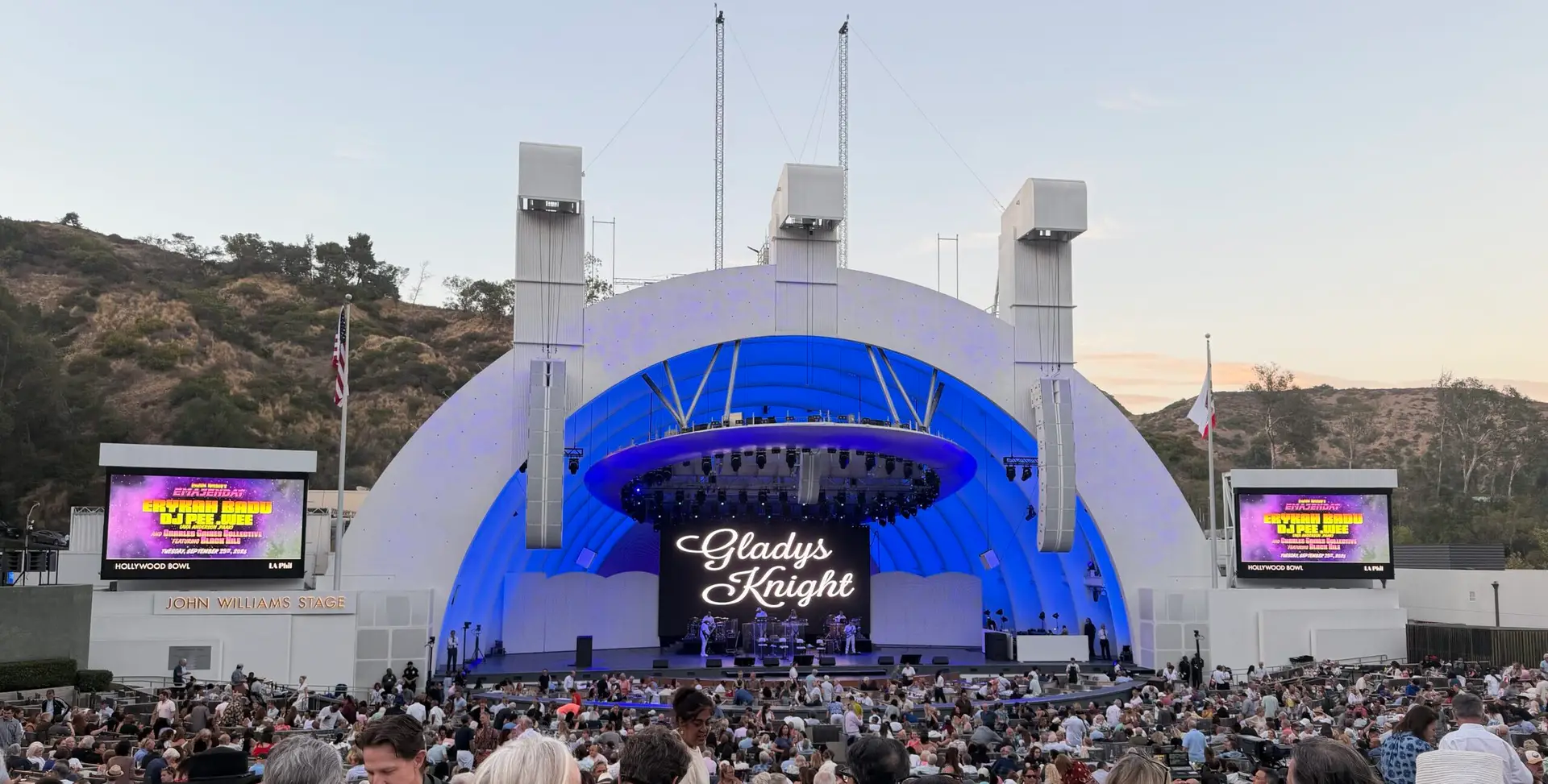
The Hollywood Bowl is still the finest summer venue in Los Angeles. I have been going for over 20 years—sometimes to see artists I love, and other times simply because I wanted to be outside, listening to music. I have never been disappointed.
But nights like this are extra special.
Gladys Knight opened the show, and this was my fourth time seeing her at the Bowl. She always delivers. It would be dishonest not to acknowledge that she is slowing down physically—you can see it in her body language—but her voice still has that unmistakable tone. The grit, the church, the elegance, and the emotional weight are still there.
Her background singers were amazing too. They did more than fill space behind a legend; they helped give the performance the lift, energy, and fullness a venue like the Bowl demands.
Then Gladys sang “Neither One of Us.”
That song will always carry a personal weight for me. My late father-in-law, James Anthony Carmichael, was one of the arrangers on that record. Hearing Gladys perform it live brought me back to some of the Motown stories he used to tell. A few of those stories I have been sworn to secrecy on forever—and I will honor my word. Nothing crazy. But enough to know that behind those timeless records were real people, real personalities, long hours, and a level of musical decision-making most people never get to see.
That is what makes songs like “Neither One of Us” so lasting. A great singer is only part of it. The writers, arrangers, musicians, producers, and background vocalists all help turn a song into a complete world.
Smokey Robinson followed, and he was amazing. This was my second time seeing him at the Bowl. At 86 years old, he is still performing, and most importantly, he still sounds like Smokey. He was never much of a dancer, even in his prime, so that is not what people came to see. His gift has always been his voice, his elegance, his phrasing, and his ability to make romance sound like poetry.
He performed classics including “Cruising”, “Being With You,” “The Agony and the Ecstasy,” and “Quiet Storm,” keeping the night full of high energy and good spirits.
My father taught me about love and how to treat women through Smokey Robinson’s lyrics. That may sound simple, but for a lot of Black American men, music was part of our emotional education. Smokey’s songs taught tenderness, longing, accountability, and romance without making any of it sound weak.
It was also good to see legendary Motown writers Mickey Stevenson and Eddie Holland in attendance. Their presence was a reminder that this was more than a nostalgia show. These are living architects of the Motown sound—the people who helped create the music that taught generations how to love, dance, hurt, and heal.
The Hollywood Bowl itself remains an elevated experience. The box seats have great service, and you no longer have to order food ahead of time; there are QR codes at your seat for ordering. Or you can do it the Los Angeles way: bring your own food and beverages and make a real night of it.
Yes, walking up that hill can be a minor inconvenience. But once you are seated under that Bowl shell, it is worth it every time.
If you are ever in Los Angeles during the summer, catch a show at the Hollywood Bowl. It almost does not matter who is playing—you will probably have a great time. But when the night belongs to Gladys Knight and Smokey Robinson, two artists my parents raised me on and whose music I have come to understand differently as an adult, it becomes more than a concert.
It becomes a memory.