
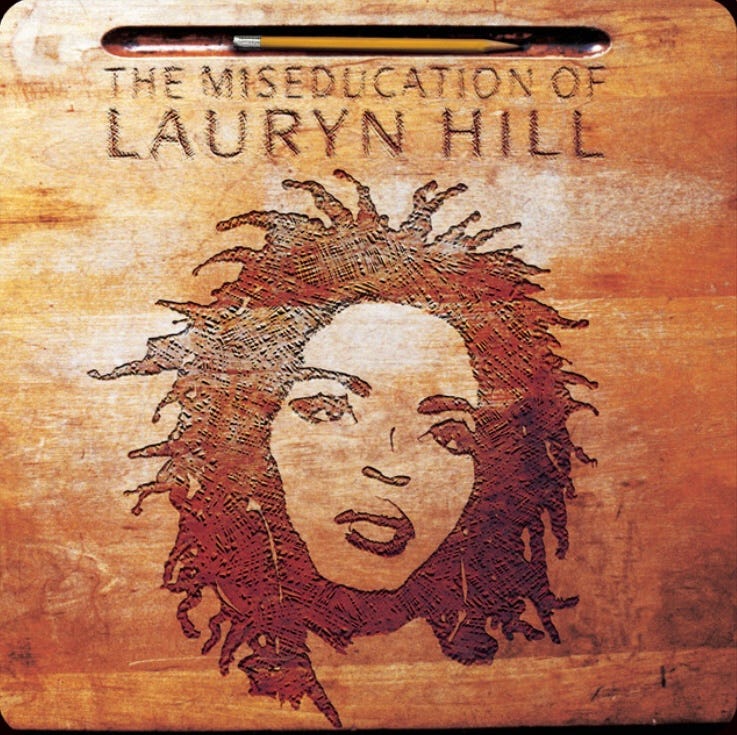
Why The Miseducation of Lauryn Hill Is a Genre-Bending R&B Album
Few albums in modern music have been debated and categorized as much as The Miseducation of Lauryn Hill. Some call it a hip-hop album. Others place it in neo-soul. Some simply call it conscious rap with R&B influence. But the confusion mostly comes from how modern audiences think about genres. When we look at the deeper history of Black American music, the answer becomes clearer. The Miseducation of Lauryn Hill belongs to a long tradition of Rhythm & Blues albums that blend multiple musical styles while remaining rooted in soul. The album incorporates gospel, doo-wop, funk, reggae, jazz harmony, and hip hop, but that kind of musical blending has always been the norm in Black American music.

R&B: The Catch-All Category for Black American Music
For most of the twentieth century, Rhythm & Blues was not a narrow genre. It was a broad category used to describe Black American popular music.
R&B historically included elements of:
- gospel
- blues
- jazz
- doo-wop
- funk
- soul
- spoken word / rap
- and later hip hop
The music was unified less by rigid sonic rules and more by shared musical foundations—groove, gospel harmony, improvisation, and rhythmic vocal expression.
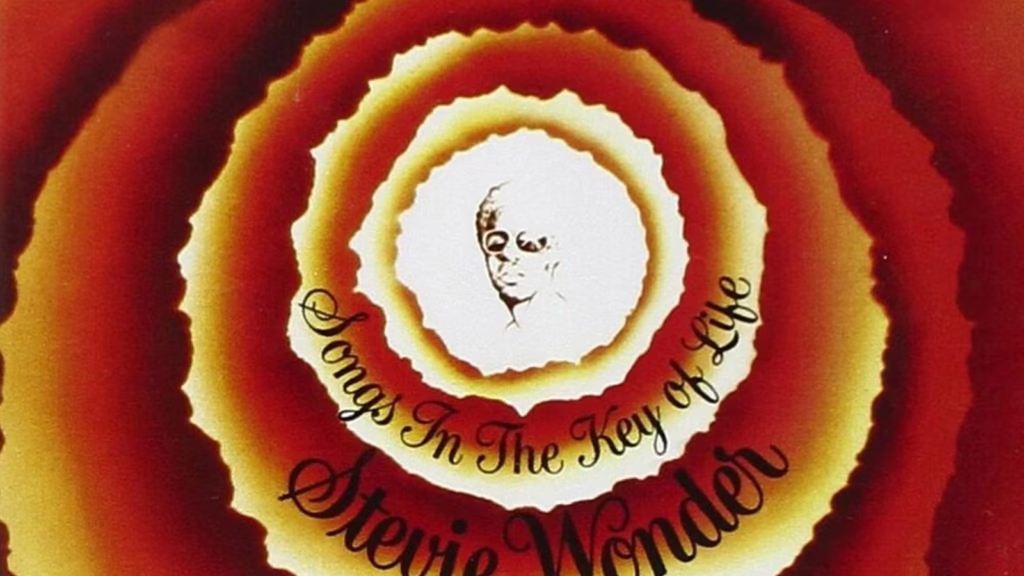
That is why so many classic Black American albums move effortlessly across styles. Stevie Wonder’s Songs in the Key of Life blends funk, jazz, gospel, pop, and orchestral music. Earth, Wind & Fire’s That’s the Way of the World fuses orchestral arrangements, funk rhythm, jazz harmony, and gospel vocals.
Lauryn Hill’s The Miseducation of Lauryn Hill continues that same tradition.
The Multi-Genre Tradition of R&B Records
Before the mid-1980s, it was common for an R&B album to incorporate several musical traditions within one project.
A record could include:
- gospel harmonies
- jazz chord structures
- funk rhythm sections
- blues phrasing
- soul ballads
- rhythmic spoken storytelling
Black American music historically functioned as a continuum rather than a set of isolated genres.
But by the late 1980s and early 1990s, mainstream R&B production began shifting toward a more electronic sound. Drum machines, synthesizers, and programmed beats increasingly replaced live musicianship. Neo Soul Study Guide
As that shift took place, some artists began reconnecting with the deeper traditions of soul music—bringing back live bands, gospel vocal phrasing, jazz harmony, and groove-based rhythm sections. Neo Soul Study Guide
This revival created the environment in which Lauryn Hill’s album would emerge.
Neo-Soul: The Closest Category in the Late 1990s
Within the way the music industry categorized genres in the late 1990s, the label that most closely fits The Miseducation of Lauryn Hill would be neo-soul.
By that point, record labels and radio formats had become much more rigid in how they classified music. What had once been broadly described as R&B was now broken into smaller marketing categories. Meanwhile, mainstream R&B production had moved heavily toward programmed beats and synthesizer-driven production styles influenced by hip-hop rhythm. Neo Soul Study Guide
During this period, a group of artists began restoring the musical traditions that had defined earlier eras of soul music—live rhythm sections, jazz-influenced harmony, gospel vocal phrasing, and groove-centered arrangements. Neo Soul Study Guide
Artists such as:
- D’Angelo
- Erykah Badu
- Maxwell
- Tony! Toni! Toné!
helped create a renewed appetite for music built in the traditional style of Black American rhythm and blues.
Within the genre framework of the late 1990s, The Miseducation of Lauryn Hill naturally fit alongside those records. The album features the same musical ingredients associated with the neo-soul movement: live instrumentation, layered vocal harmonies, jazz chords, and groove-driven rhythm sections.
Songs like “Nothing Even Matters,” her duet with D’Angelo, place Hill directly within that musical circle.
But when we look deeper, the term neo-soul was really just a modern label placed on something much older.
Neo-soul was essentially traditional soul music being made again in the 1990s.
The label itself often functioned as a marketing category used to separate music that returned to classic Black American musical traditions during a period when mainstream R&B had shifted toward more electronic production. Many of the artists associated with the movement rejected the term altogether, arguing that they were simply making soul music in the same lineage as earlier generations.
Seen through that lens, The Miseducation of Lauryn Hill fits within the neo-soul category only because of the way genres were defined in the late 1990s. Historically, it belongs to the much older continuum of Black American soul and R&B music.
Breaking Down the Songs on The Miseducation of Lauryn Hill
One reason the album resists simple genre labels is because each song draws from a different tradition within Black American music.
“Doo Wop (That Thing)” references the doo-wop era, a vocal tradition that grew directly out of gospel quartet singing. Those layered harmonies became the foundation of later soul vocal arrangements.
“Ex-Factor” is a classic soul ballad rooted in gospel phrasing and traditional R&B chord progressions.
“To Zion” functions as a modern gospel song both musically and lyrically.
“When It Hurts So Bad” is straight soul music carried by Hill’s vocal performance.
“Nothing Even Matters”—her duet with D’Angelo—captures the essence of the neo-soul era with live instrumentation and classic soul interplay.
“The Miseducation of Lauryn Hill” is a ballad that incorporates classical elements through its orchestration.
“Can’t Take My Eyes Off You” flips a classic pop standard and transforms it through soul performance.
“Forgive Them Father” blends gospel themes with funk horn arrangements.
“I Used to Love Him,” featuring Mary J. Blige, fuses hip-hop style production with traditional R&B songwriting. Blige had already helped introduce this hybrid style earlier in the decade with songs like “Real Love.”
Rap in R&B Didn’t Begin With Hip Hop
Another reason some people classify The Miseducation of Lauryn Hill as a hip-hop album is because Lauryn Hill raps on several tracks.
But rhythmic spoken delivery in music did not begin with hip hop. It was already part of the Black American musical tradition decades earlier.
One of the earliest examples comes from Louis Jordan, often called the Godfather of R&B. Jordan regularly used rhythmic storytelling in his music. Songs like “Saturday Night Fish Fry” (1949) and “Beans and Cornbread” (1949) feature fast-paced conversational delivery over jump-blues grooves. The structure of these songs—rhythmic speech riding the groove of a band—looks very similar to what would later be called rap.
That tradition continued into the funk era.
James Brown, widely referred to as the Godfather of Soul and often called the Godfather of Hip Hop because of how heavily hip-hop producers sampled his records, also incorporated rap-style delivery into his music. Brown frequently used rhythmic spoken passages where his voice functioned like a percussive instrument riding the groove.
Examples include:
- “The Big Payback” (1973) — Brown delivers rhythmic spoken verses over a deep funk groove that closely resembles later rap cadence.
- “People Who Criticize” (1977) — a J.B.’s-era recording where Brown uses spoken rhythmic phrasing throughout the track.
- “Watergate” (1975) — recorded with the J.B.’s, featuring politically charged spoken delivery over a funk rhythm section.
Many recordings by The J.B.’s, James Brown’s backing band, also featured this style of rhythmic vocal delivery layered over heavy funk grooves.
By the late 1980s and early 1990s, this tradition of mixing rap-style passages into R&B songs was already common.
For example:
- Shanice includes a rap verse in “I Like Your Smile”, yet the song is still considered R&B, not hip hop.
- Bobby Brown and other New Jack Swing artists frequently incorporated rap-style delivery into their records.
Lauryn Hill was continuing that lineage. Her rapping on The Miseducation of Lauryn Hill sits inside a long tradition of Black American artists blending rhythmic speech with soul and funk music.
The Groove Tradition: From James Brown to Lauryn Hill

Another defining feature of the album is groove.
James Brown transformed Black American rhythm by emphasizing the pocket—the tight relationship between drums, bass, guitar, and horns.
Many songs on Hill’s album reflect that influence through:
- groove-centered rhythm sections
- horn punctuations reminiscent of Brown’s band
- arrangements driven by feel rather than rigid timing
This rhythmic language sits at the core of soul and funk music.
The Greatest Black Artists Never Stayed in One Genre
Looking at the broader history of Black American music makes one thing clear: the greatest artists rarely confined themselves to a single genre.
Michael Jackson’s albums often moved across styles within the same record.
On Thriller:
- “Beat It” leans into rock
- “Billie Jean” is driven by funk rhythm
- “The Lady in My Life” is a traditional R&B ballad
Prince did the same on Purple Rain:
- “Purple Rain” carries strong country and gospel influence
- “Let’s Go Crazy” blends gospel energy with blues rock
- “Take Me With U” leans toward pop
These albums were never restricted to one genre. They were expressions of Black American musical creativity.
Did Lauryn Hill Incorporate Hip Hop?

Yes.
Lauryn Hill incorporated hip-hop rhythm and rap into parts of the album.
But the key question is this:
Was the album dominated by hip hop?
The answer is no.
The musical foundation of The Miseducation of Lauryn Hill remains rooted in:
- gospel harmony
- soul vocal tradition
- funk rhythm
- R&B songwriting
- live instrumentation
Hip hop appears as one element within a broader musical framework.
Soul and Spirit: The Core of Black American Music
Modern genre labels often make music appear more rigid than it actually is.
But the musical traditions created by Black Americans all emerge from the same cultural source.
Rock
R&B
Blues
Funk
House
Hip hop
Pop
These are not separate musical worlds.
They are different expressions of the same soul and spirit.
And the greatest artists—from Ray Charles to Stevie Wonder to Michael Jackson—sound powerful no matter which expression of soul music they choose to sing through.
A Classic in the Tradition of Black American Music
When viewed through the full history of Black American music, The Miseducation of Lauryn Hill becomes easier to understand.
It is not simply a hip-hop album.
It is not confined to neo-soul.
It is a classic R&B album in the traditional sense—a musical statement that draws from multiple traditions while remaining rooted in soul.
That is what the greatest Black American albums have always done.
And that is why The Miseducation of Lauryn Hill remains one of the most important R&B records ever created.